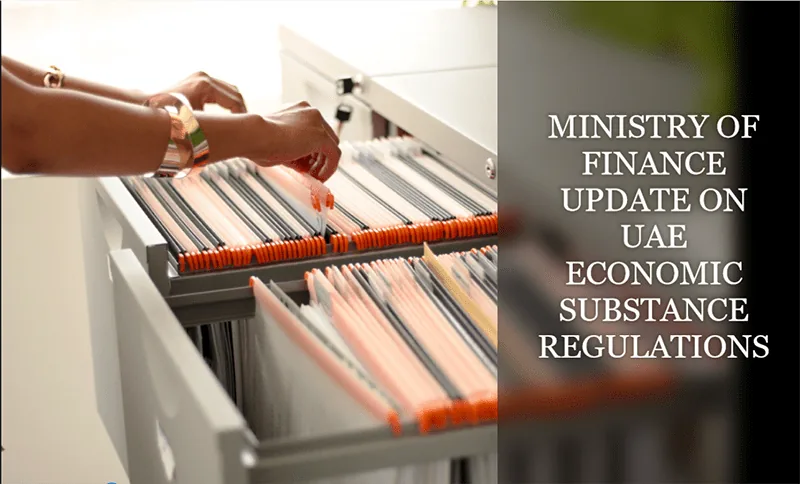

The UAE Ministry of Finance on 7 August 2026 announced a three-year extension of Small Business Relief for corporate tax. Ministerial Decision No. 131 extends the relief to tax periods ending on or before 31 December 2029. The AED 3 million annual revenue threshold stays unchanged.
This is one of the most practically important tax updates of the year for UAE SMEs: thousands of small businesses that were facing the SBR cliff at 31 December 2026 now get up to three more zero-CT years — provided they keep revenue within the cap.
What the extension actually does
Small Business Relief was introduced in 2023 by Ministerial Decision No. 73 of 2023 under Federal Decree-Law No. 47 of 2022 — the UAE Corporate Tax Law. The rule: a UAE-resident company or self-employed person with annual revenue at or below AED 3 million can elect SBR — and is then treated as having zero taxable income for the tax period. The standard 9% corporate tax rate on taxable income above AED 375,000 does not apply in that period.
In the original design, the relief was available for tax periods starting on or after 1 June 2023, but only for those ending on or before 31 December 2026. That meant a hard sunset: the FY ending 31.12.2026 was the last in which SBR could be claimed.
Ministerial Decision No. 131 pushes that sunset out to 31 December 2029. The AED 3M threshold is unchanged. The revenue measurement rules, the obligation to register for corporate tax, to file the simplified return and to elect SBR via the return — all remain the same.
Primary source and the MoF position
The Ministry of Finance press release was issued on Friday, 7 August 2026. The ministry framed the extension as support for entrepreneurs and reinforcement of the UAE business environment. Eligible businesses continue to benefit from simplified corporate tax compliance requirements; the election is made when the simplified return is filed.
The release does not carry verbatim quotes from named officials. The regulatory acts underpinning MD No. 131 are Federal Decree-Law No. 47 of 2022 (Corporate Tax Law) and Ministerial Decision No. 73 of 2023 (the original SBR framework).
What this means for SMEs and founder-led structures
Economically, the extension produces three layers of upside:
- Three additional zero-CT years. An SME with revenue within the cap and a 31 December year-end gets three full zero-CT periods: 2027, 2028, 2029. For non-calendar year-ends — three corresponding FYs ending in the same window.
- Softer threshold dynamics. A business at AED 2.8–2.9M revenue was previously already having to model the 2027 transition into standard 9%-above-AED-375,000 CT. It now has a window to either stabilise revenue below the cap or restructure without an immediate tax cliff.
- Founder economics. For founders planning to set up a company in the UAE in 2026–2027 with revenue of AED 1–2M in the first two-three years, the SBR window now cleanly covers the entire ramp-up phase. That reshapes the unit economics of the business model at inception.
How this fits into the broader UAE CT framework
Small Business Relief is not an abolition of corporate tax — it is a preferential regime within it. The overall UAE CT architecture stands: 0% on the first AED 375,000 of taxable income, 9% above; a Domestic Minimum Top-up Tax regime applies to large MNE Groups (revenue > AED 3.15 billion). SBR is a separate layer for micro and small businesses that removes the taxable-income calculation and allows a simplified return. For the base rules on who pays the UAE 9% corporate tax and on what basis, see the portal's foundation guide.
Simplified return deadlines under SBR do not disappear: for an FY ending 31 December 2025, the deadline is 30 September 2026 (nine months after year-end). The FTA has previously emphasised that eligibility for SBR does not remove the obligation to register for corporate tax, file the return, and keep supporting documentation.
Practical SME checklist through 2026
- Aggregate revenue for each relevant tax period from 1 June 2023 through 31 December 2025 (and, as it closes, 2026). Confirm the AED 3M threshold has not been exceeded in any period.
- Confirm the company is registered for CT in EmaraTax; check taxable person status.
- For the FY ending 31.12.2025, file the simplified return and make the SBR election by 30 September 2026.
- Bake a three-year plan (2027–2029) for keeping revenue within the cap into strategy — it is a real 9% saving on profit above AED 375,000.
- If the actual trajectory pushes revenue above AED 3M, recut the model to standard 9% CT, including an assessment of any group/subsidiary restructuring.
What comes next
The extended SBR window (through 31.12.2029) is a strong policy signal that the UAE intends to keep the SME layer inside a preferential regime on a medium-to-long horizon. It aligns with the wider line: refreshed UAE business regulation in 2026, ongoing e-invoicing rollout, and further detail on CT-registration rules. Additional technical ministerial decisions covering specific transaction types and tax periods are expected from MoF and the FTA through 2026–2027. Track them directly on mof.gov.ae and tax.gov.ae.
This article is informational and is not a substitute for tailored corporate tax advice for the UAE. Current Small Business Relief rules, election procedure, return deadlines and exclusion lists should be verified against mof.gov.ae, tax.gov.ae and with a qualified adviser for your specific situation.